

The Future of Language Learning: Traditional Learning vs. Online Learning
Mar 16, 2026 • Redparrot
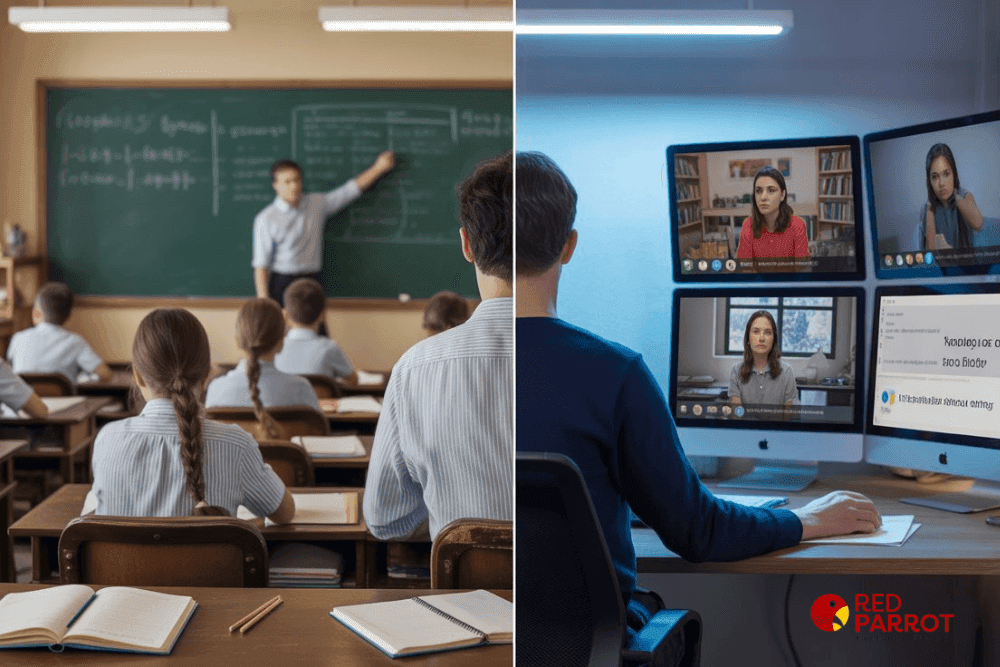
Traditional Learning Methods: In-Person Language Classes and Their Impact
The traditional learning of languages has been in existence for several years, nay centuries. It does come with several advantages. Face-to-face interaction with the instructors offers immediate corrections and real-time feedback. Research has indicated that physical classrooms foster deeper cultural immersion.
The structural environment offered by the traditional classrooms creates accountability mechanisms. Some of the factors that you will benefit from include regular attendance requirements, fixed schedules, and peer-group dynamics that cultivate discipline and sustained motivation. This human-centered approach leverages emotional intelligence to address learners’ confidence levels and unique challenges.
The traditional method provides an immersive linguistic environment where students get a constant exposure to the target language. You will encounter the real world interactions that are quite close to the real world scenarios. It can also lead to a community formation, which further enables you to have shared goals and mutual encouragement.
The Rise of Online Language Learning: Flexibility, Accessibility, and Convenience
The growth of online classes for language learning provides a fundamental shift in terms of technological capabilities. The traditional classrooms come with a constraint of physical location. Online classes provide an unpredictable flexibility. The learners have the option to choose the course and material at any time they prefer across different time zones. This should make learning languages easy for the professionals, parents, and geographically isolated students.
Moreover, the online classes provide students with an option for personalised learning. Traditional classrooms have a limitation where the standard pace may leave some of the students overwhelmed. The online classes can be customised with visual storytelling, flashcard repetition, or interactive exercises tailored to each student’s optimal acquisition path.
The online classes also eliminate the commute costs and time constraints typically faced by the students. This can be quite true in the case of less commonly taught languages like Malayalam or Arabic. Check out the courses conducted by Red Parrot Language Learning School. They offer comprehensive online courses that connect expert Kerala-based instructors with students globally.
Comparing Traditional vs. Online Language Learning: Key Differences You Should Know
The table below should provide a good insight into the online learning and traditional learning.
| Feature | Traditional Classroom | Online Language Learning |
|---|---|---|
| Interaction Style | Face-to-face, real-time conversation with immediate feedback | Digital interface, often asynchronous, limited spontaneous dialogue |
| Scheduling | Fixed timetable requiring physical presence | 24/7 access, self-paced progression |
| Cost Structure | Higher expenses, including commuting, materials, and facility overhead | Reduced costs, no travel expenses, scalable digital resources |
| Learning Pace | Uniform class speed may not suit all learners | Adaptive algorithms personalize progression |
| Technology Needs | Minimal technical requirements | Requires stable internet, devices, and digital literacy |
| Social Component | Peer bonding, group dynamics, cultural immersion | Virtual communities often isolated experience |
| Discipline Requirement | External structure enforces accountability | High self-motivation and time management are essential |
| Oral Skills Development | Superior for pronunciation and conversational fluency | Limited speaking practice, challenges in oral assessment |
The primary difference between the two methods is the mechanism of feedback. Traditional classrooms provide instant guidance as part of a natural flow of conversation. Online classes do offer the feedback, but it may be limited in its capability.
How Technology is Shaping Online and Traditional Methods?
The power of artificial intelligence has been at the centre point of both traditional and online classes. Advanced AI capabilities today deliver real-time feedback on pronunciation, fluency, and rhythm through conversational chatbots and intelligent tutoring systems. The technology is also at the forefront of enabling practice opportunities.
Virtual and augmented reality are the other technologies that represent a global shift in terms of language learning. This “learn-by-doing” approach accelerates practical skill acquisition.
Choosing the Right Language Learning Method: Online or Traditional – What’s Best for You?
Choosing between traditional learning and online learning requires you to have an honest assessment of personal circumstances and your learning preferences. Online learning should be the right choice for self-directed individuals comfortable with technology who require schedule flexibility due to work, family, or geographical constraints. It needs a strong time management.
Traditional classrooms are the best option for the learners who love direct human interaction. You will also benefit from it if you want immediate feedback and peer accountability. This approach also serves those prioritizing oral fluency, as spontaneous conversation practice remains the gold standard for developing authentic speaking ability.
The hybrid options would serve optimal results. Most of the learners achieve the best results by combining online vocabulary and grammar practice with in-person conversation classes. That is how Red Parrot works in imparting language learning
Check your goals, and analyse the best options that work best for you. Both online learning and offline learning offer equally beneficial results.
Conclusion: What the Future Holds for Language Learners – Embracing Both Traditional and Online Education
The effective language learning should be about the synthesis of both methods. The focus should be on the adaptive approach. Technology will continue enhancing traditional classrooms through AI-assisted lesson planning and performance tracking. The online platforms will incorporate more sophisticated human interaction through VR and advanced chatbots.
Red Parrot Language Learning School is a language learning institute in Kerala that embodies this future-ready philosophy. We specialise in Malayalam and Arabic instruction. Our approach blends Online language learning with a cultural expertise.
The future of language learning is not about replacing teachers with technology. It is about empowering both to serve learners more effectively than ever before.
Leave a Reply
Your email address will not be published. Required fields are marked *
STAY CONNECTED WITH RED PARROT SCHOOL
Stay updated on new programs, resources and language learning insights

Information
- Red Parrot Language School.
- No. 4/461, 2nd Floor Suite No. 399 Valamkottil Towers Judgemukku, Kakkanad, Kochi, Kerala 682021
- info@redparrotschool.com
- 9037495104